flowchart LR
    A["Focused work"] <--> B["Goal setting"]
    B <--> C["Collaborative work"]
    C <--> A
SOP
We rely on standard operating principles to make high-quality contributions to research, teaching, and practice. These principles summarize effective methods for staying focused on priorities, organizing projects efficiently, and coordinating our efforts.
Work sessions
We balance focused and collaborative work to foster deep intellectual engagement. Focused work allows for concentrated thinking, reading, and writing, while collaboration through co-working and knowledge-sharing sessions enhances idea exchange and teamwork. Alternating between these modes helps maintain productivity and creativity.
Goal setting
Goal setting is an intentional practice to clarify what matters most, individually and as a team. In regular planning and review sessions, we reflect on our progress, define objectives, and identify key results that align with our broader mission.
We encourage everyone to:
- Take ownership of personal and shared goals
- Translate ideas and ambitions into actionable plans
- Review and refine goals regularly to adapt to evolving priorities
- We use our agenda repositories to document our objectives and track progress
Goal setting is not just about productivity—it’s about working purposefully and making our efforts count.
Focused work
Our most important resource is focused work. Everyone may have a slightly different recipe on how to “get into the zone”. The following may be helpful to experiment:
- Blocking time slots for focused work (e.g., in the morning), and switching off e-mail and phones.
- Using distraction blockers like Freedom or Forest
- Working with techniques like Getting-Things-Done (GTD), bullet-journaling, daily priority lists, or Pomodoro
- Taking time to recharge every day, work out, and take vacations
Collaborative work
- Regular co-working sessions
- Planning and review sessions (with hands-on)
- Knowledge-sharing sessions (e.g., on creating a revision strategy)
Note
Co-working sessions
- Invitations will be shared at the beginning of the semester.
- We set a recurring weekly date primarily for the convenience of scheduling.
- Attendance is optional — join if you find it helpful for your projects (e.g., to discuss challenges or work alongside others).
- No need to confirm attendance or notify if you can’t make it.
- Sessions are often followed by an informal team lunch — feel free to join!
Work protocol
Our goal is to work on shared repositories (courses, projects, agendas), which serve as a “single point of truth”. For example, there should always be a specific repository containing the current version of a research paper, along with the version history, ongoing work in branches or pull requests and open issues. We try to avoid sending direct messages and documents as much as possible. Collaborating in these repositories has many benefits: repositories provide context (clearly identifying the project, its history, ongoing work, and open issues), llow us to reduce direct messages (the cognitive effort to search for related documents and coordinate asynchronous work), and use scripts like Labot for automation.
flowchart LR

    subgraph task["III. Task"]
        U["Has it been done before?"] -->|check handbook documentation, prior issues, including closed ones, and discussion| J
        J{How specific is it?}
        J -->|open question, task with no or minimal changes| K["Open an issue"]
        J -->|Change with an initial suggestion| L["Open a pull-request"]
    end

    subgraph scope["II. What"]
        direction LR
        E{What is it?}
        E -->|general, procedural| F["Handbook"]
        E -->|general, knowledge, communication| G["research-hub (Knowledge management, discussion and team issues) 🔒"]
        E -->|specific| H["Teaching or research repository (?)"]
        E -->|individual| P["Agenda 🔒"]

    end

    subgraph confidentiality["I. Confidentiality"]
        direction LR
        B{Is it confidential?}
        B -->|yes| C["Private repository 🔒"]
        B -->|no| D["Private or public repository (?)"]
    end

    style task fill:white,stroke:#333,stroke-width:3px
    style scope fill:white,stroke:#333,stroke-width:3px
    style confidentiality fill:white,stroke:#333,stroke-width:3px
Principles
- Use GitHub issues and agendas for task management
- Share (deep) links to our handbook processes or other repository resources when collaborating
- Use consistent naming, including our unique project names and the
YYYY-MM-DDformat for dates
NoteDetails
GitHub issues for task management
We use one system to manage tasks: GitHub (issues). Issues offer a continuous thread for a given task with several advantages:
- All task-related information is collected in one place
- We can link other resources or upload files
- We can mention others (e.g.,
@geritwagner: can you help me with …?), asking them to contribute - We can work on shared issues with colleagues, but also with external stakeholders, such as researchers from other universities or students
- Issues can be linked to pull requests
- We can share (deep) links to issues, giving recipients context on the task (unlike e-mails where finding context can be time-consuming)
- GitHub offers templates to structure recurring tasks
- It is easy to write scripts that access, create, or contribute to issues
- Closed issues offer a historical record of past decisions and work procedures
Best practices
- Carefully decide in which repository the issues should be created. Issues are specific to a repository and have the same visibility (private or public).
- Mention colleagues instead of writing a separate e-mail.
- Regularly check GitHub’s overview of all open issues assigned to you or with mentions.
Sharing with deep links
A deep link is a URL that points directly to specific content within a page, rather than to the general page or document itself. This allows users to access the exact information or context they need without having to navigate or search within the broader resource.
Examples of deep links:
Specific element in our handbook:
Selected slide in our project:
https://fs-ise.github.io/open-source-project/output/06-best_practice.html#technical-setupA comment in an issue discussion:
https://github.com/fs-ise/digital-work-lecture/issues/8#issuecomment-2199793685
How to create a deep link
Click on the anchor and copy the URL:
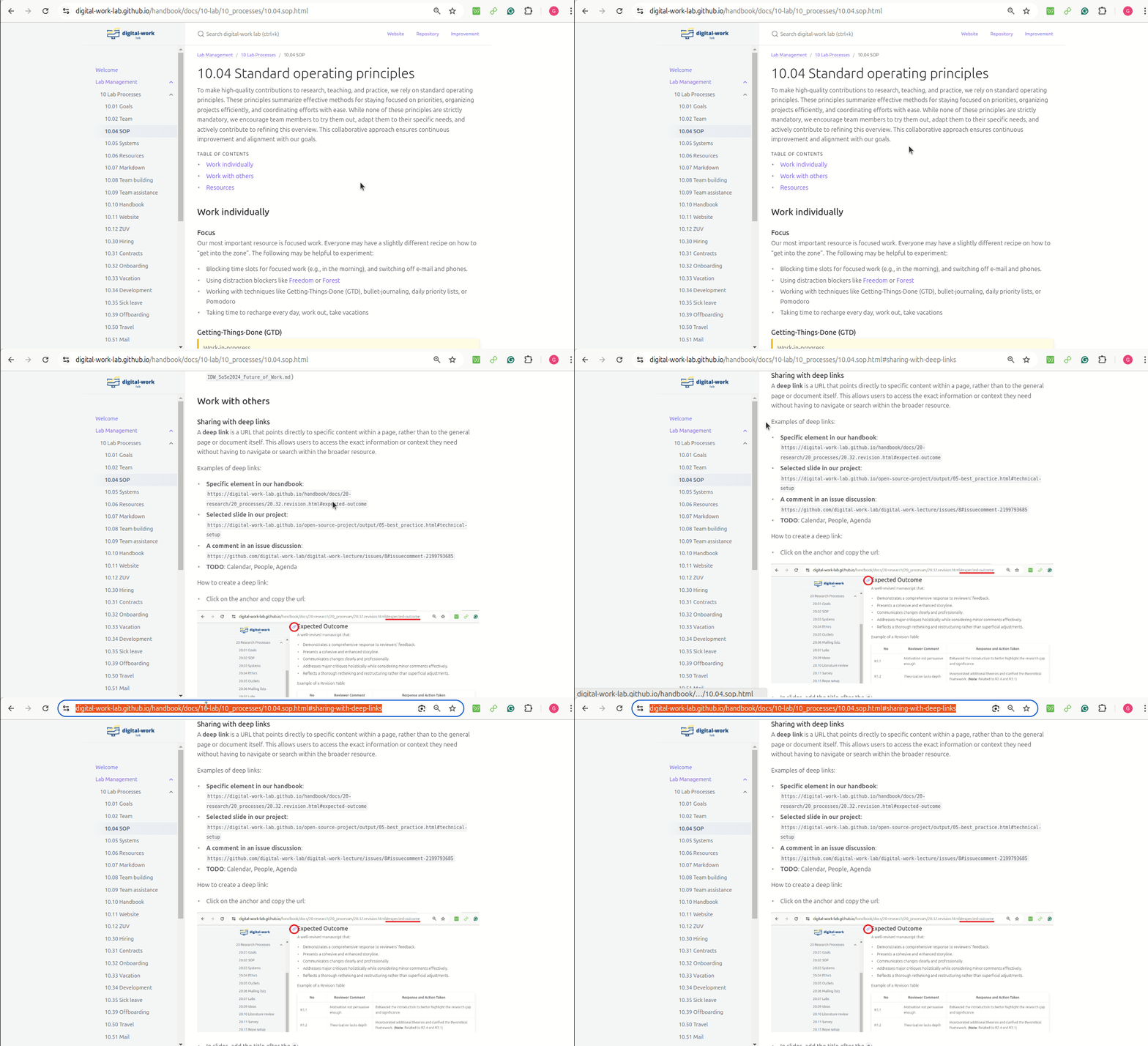
Deep-link example handbook In slides, add the title after the
#: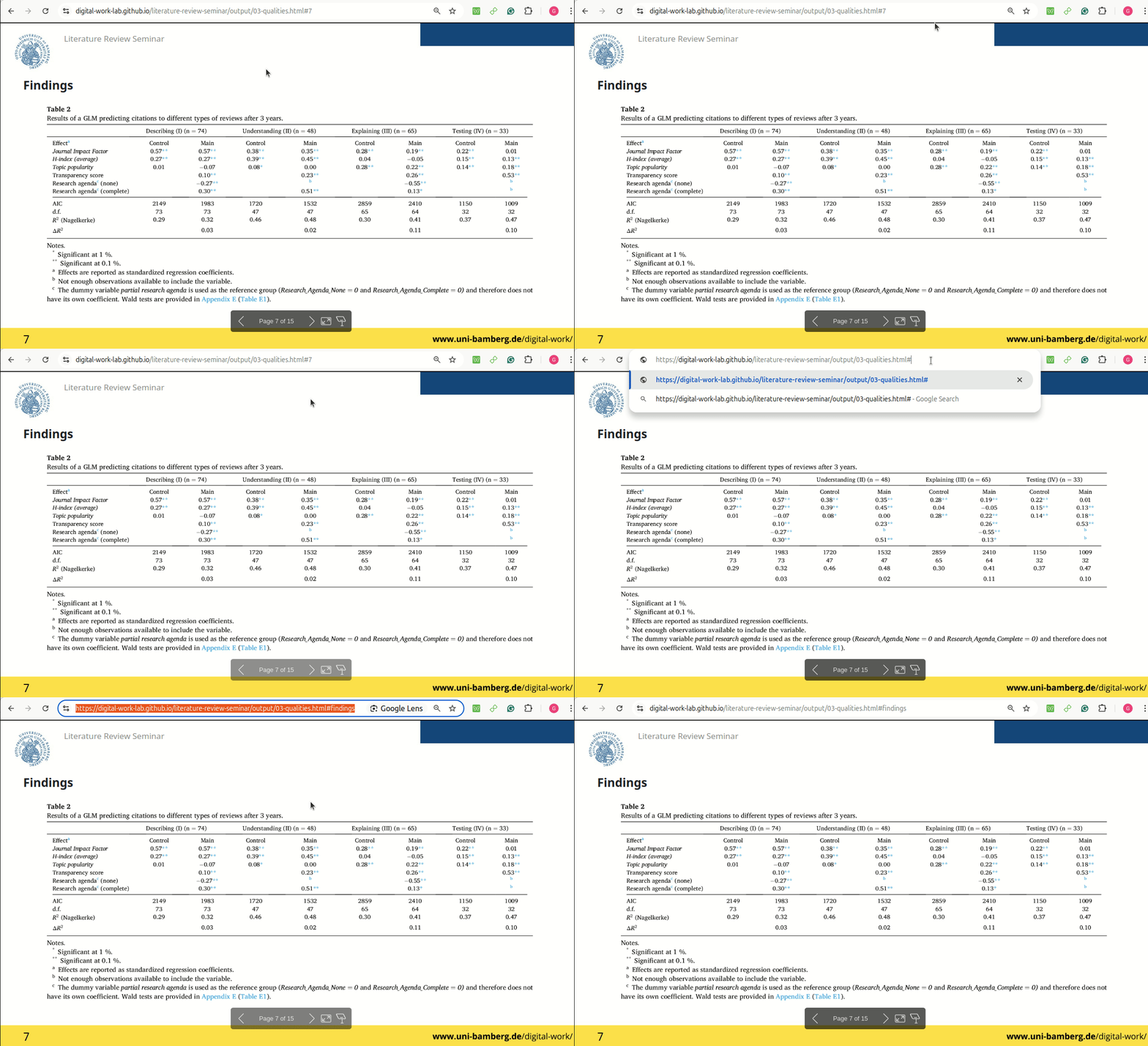
Deep-link example slides
Why use deep links
Precision and clarity
Deep links provide targeted access to relevant content, which reduces ambiguity and ensures recipients understand the exact context being referenced.Improved collaboration
Sharing specific parts of documents or discussions encourages grounded and focused discussions, avoiding the inefficiency of reading or interpreting an entire document.Asynchronous workflows
Deep links support modern collaborative practices by making resources easy to share, revisit, and update over time without additional explanation or redundant actions.Enhanced discoverability
They create a networked “knowledge graph,” allowing users to explore related information seamlessly through interconnected resources.Time and effort savings
By bypassing the need to search within a page, deep links save time for all collaborators.
See Ben Balter’s post.
Note
TODO : add examples, link items in the figure
Resources
- GitLab: Handbook-first principle
References
Allen, D. (2001). Getting things done: The art of stress-free productivity. Viking.
Gawande, A. (2010). The checklist manifesto: How to get things right. Penguin Books India.