Show the code
from prisma_flow_diagram import plot_prisma_from_records
plot_prisma_from_records(records_path="/home/gerit/ownCloud/data/literature_reviews/LRDM/C5-DM-vignette/data/records.bib", show=True)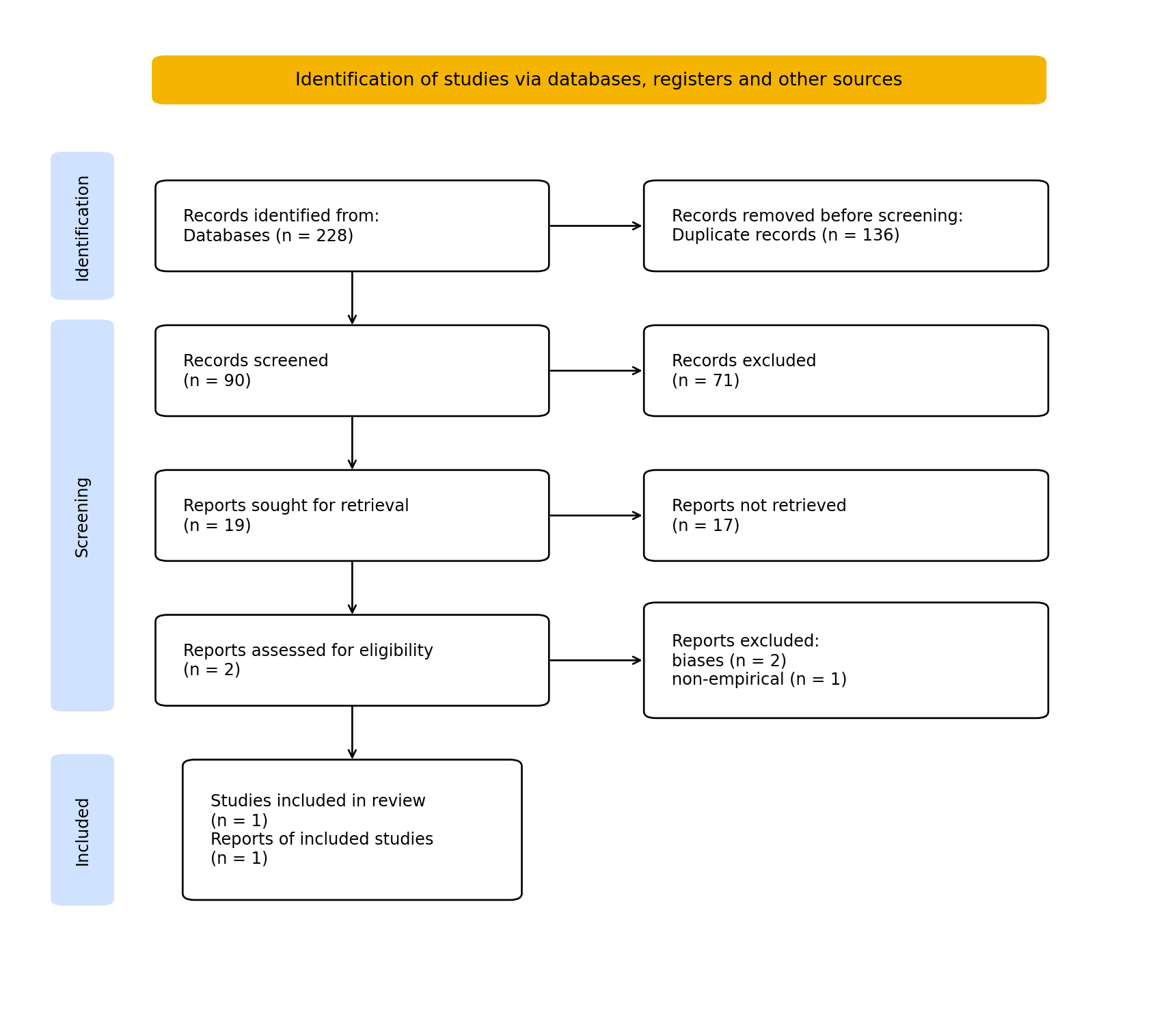
Building on the C5-DM framework for data management in literature reviews (Wagner et al. 2026), this vignette illustrates how data management principles can be implemented in a literature review. The framework foregrounds data conceptualization, collection, curation, control, and consumption as foundational activities that shape the transparency, reliability, and reuse of literature review outcomes. The vignette is organized into two complementary parts. The middle column presents a systematic literature review following established reporting conventions. The right column explains how the manuscript is internally grounded in explicit data management decisions aligned with the C5-DM framework, adding an interactive layer of annotations that makes these decisions visible. The vignette thus serves as a concrete illustration of good data management practice in literature reviews—one that readers can follow directly in their own work while also sharpening their understanding of what to look for when evaluating other software solutions and data management approaches.
This column explains how the data management principles are implemented. ⬇️
This review focuses on worker selection decisions in online labor markets. In line with qualitative systematic reviews (Higgins and Green 2008; Smith et al. 2011), it aims at collecting evidence from prior empirical studies and aggregating it.
The review is conducted using a shared GitHub repository, which was synchronized locally by the team.
We specified search strategies for the Crossref and DBLP application programming interfaces (APIs)1 using the core keyword microsourcing and a set of semantically related synonyms. We also reused samples from prior reviews (Wagner, Prester, and Paré 2021; Fiers 2023). The resulting query formulations were systematically tabulated to document the conceptual scope of the search and to enable consistent execution across data sources (see Table 1).
import json
from pathlib import Path
from urllib.parse import quote

SEARCH_DIR = Path("data/search")

def md_link(text: str, target_path: str) -> str:
    target_path_posix = Path(target_path).as_posix()
    url = target_path_posix
    return f"[{text}]({url})"


json_files = sorted(SEARCH_DIR.glob("*.json"))

rows = []
for jf in json_files:
    try:
        data = json.loads(jf.read_text(encoding="utf-8"))
    except Exception:
        continue

    label = (data.get("label") or jf.stem).strip()
    results_path = (data.get("search_results_path") or "").strip()

    # Render links in the same "data/search/..." style as in your manual table
    json_link_target = f"data/search/{jf.name}"
    search_strategy_cell = md_link(jf.name, json_link_target)

    search_results_cell = (
        md_link(Path(results_path).name, results_path)
        if results_path
        else ""
    )

    rows.append((label, search_strategy_cell, search_results_cell))

print("::: {#tbl-search-overview}")
print("Table: Overview of search strategies and results.\n")
print("| Source | Search strategy | Search results |")
print("|:--------|:-----------------|:----------------|")
for s, strat, res in rows:
  print(f"| {s} | {strat} | {res} |")
print("\n:::")| Source | Search strategy | Search results |
|---|---|---|
| Prior review: Fiers (2023) | Fiers2023_search_history.json | Fiers2023.csv |
| Prior review: Wagner, Prester, and Paré (2021) | WagnerPresterPare2021_search_history.json | WagnerPresterPare2021.bib |
| Crossref (API search) | crossref_search_history.json | crossref.bib |
| DBLP (API search) | dblp_search_history.json | dblp.bib |
The search strategies are stored in JSON format together with the raw data files in the data/search directory, in line with the standard of Haddaway et al. (2022).
Metadata was prepared using CoLRev and extensions (Wagner and Prester 2025). Deduplication was done using BibDedupe (Wagner 2024).
Trigger: Records in data/records.bib are in colrev_status = {md_prepared}
Responsible: Review coordinator
Command:
colrev dedupeOutput (in data/records.bib): Duplicates resolved and records set to md_processed (ready for prescreen)
Validation: Run colrev validate after committing
History filter: dedupe
For prescreening, we tested a new LLM-based prescreened. Comparison with prescreening decisions of GW showed low reliability with the llm-prescreener. Results were therefore reverted and a fully manual prescreen was implemented.
Trigger: data/records.bib updated
Responsible: Two independent coders (GW and JP)
Protocol: screening procedures and criteria (see protocol/screening.md)
Output: records_screened.bib
History filter: prescreen
For full-text screening, PDF documents were retrieved and prepared.
Trigger: Records in data/records.bib with colrev_status = {rev_prescreen_included}
Responsible: Review coordinator (pdf-get/pdf-prep) and individual reviewer (pdf-get-man/pdf-prep-man)
Commands:
# 1) pdf-get: automated retrieval and linking of PDFs
colrev pdf-get

# 2) pdf-get-man: manual retrieval for remaining missing PDFs
colrev pdf-get-man

# 3) pdf-prep: automated PDF preparation (OCR/text extraction/checks)
colrev pdf-prep

# 4) pdf-prep-man: manual fixes for remaining problematic PDFs
colrev pdf-prep-man
Output (in data/records.bib):
file = {data/pdfs/<...>.pdf} and advanced to colrev_status = {pdf_imported}.colrev_status = {pdf_prepared}.pdf_needs_manual_preparation and must be resolved via colrev pdf-prep-man before they are set to pdf_prepared.Notes: PDF retrieval depends on institutional access, licensing constraints, and rate limits.
History filters: pdf-get · pdf-get-man · pdf-prep · pdf-prep-man
Records were screened independently, as described in the following.
Trigger: Records in data/records.bib with colrev_status = {pdf_prepared}
Responsible: Two independent coders (GW and JP)
Protocol: full-text screening procedures and criteria (see protocol/fulltext_screening.md)
Process:
screening_criteria, screening_decision, screening_reason) according to the protocol.Output (in data/records.bib):
colrev_status = {rev_screen_included}colrev_status = {rev_screen_excluded} (with documented exclusion reason)History filter: screen
In line with the methodology of systematic reviews (Higgins and Green 2008; Smith et al. 2011), we selected structured data forms to extract evidence from the studies.
Trigger: data/records.bib updated
Responsible: Two independent coders (GW and JP)
Protocol: data extraction form and protocol (see protocol/data_extraction.md)
Output: extracted_evidence.yaml
History filter: data
The narrative synthesis is in the paper document in Markdown format, allowing for larger teams to work on the same document (similar to the covid19-review). The current status of the project is automatically updated with every change and reflected in the PRISMA flow diagram (Figure 1, in line with the recommendations of Page et al. (2021)).
In [2]:
from prisma_flow_diagram import plot_prisma_from_records

plot_prisma_from_records(records_path="/home/gerit/ownCloud/data/literature_reviews/LRDM/C5-DM-vignette/data/records.bib", show=True)Table 2 provides summary of extracted evidence.
In [3]:
from pathlib import Path
import yaml
import pandas as pd
import matplotlib.pyplot as plt

yaml_path = Path("data/evidence_platform_work_biases.yml")

with yaml_path.open("r", encoding="utf-8") as f:
    doc = yaml.safe_load(f)

df = pd.DataFrame(doc.get("papers", []))

cols = [
    "study_id", "citation_key", "year", "platform", "platform_type",
    "method", "data", "sample",
    "bias_type", "bias_mechanism",
    "outcome_affected", "evidence_level", "direction_of_bias",
    "key_result", "notes",
]
df = df[[c for c in cols if c in df.columns]]

df["year"] = pd.to_numeric(df.get("year"), errors="coerce").astype("Int64")
df = df.sort_values(["bias_type", "evidence_level", "year"], na_position="last").reset_index(drop=True)

compact_cols = [
    "citation_key", "platform_type", "bias_type",
    "outcome_affected", "key_result"
]
df_compact = df[compact_cols].rename(columns={"citation_key": "study"})
df_compact
In [3]:
| study | platform_type | bias_type | outcome_affected | key_result | |
|---|---|---|---|---|---|
| 0 | RosenblatEtAl2018 | ride_hailing | algorithmic_visibility_bias | task_access | Algorithmic control mechanisms differentially ... |
| 1 | KuehlEtAl2022 | online_freelance | experience_lock_in_bias | matching_probability | Early experience thresholds significantly redu... |
| 2 | WoodEtAl2019 | online_labor | geographic_bias | wages | Workers in low-income countries receive system... |
| 3 | HannakEtAl2017 | online_marketplaces | rating_bias | reputation_scores | Online reputation systems encode demographic b... |
| 4 | CookEtAl2018 | accommodation | rating_bias | booking_probability | Hosts with African-American–sounding names rec... |
To make the review reusable, the data was published on GitHub under the CC BY 4.0 license2.