Store search results separately from the primary data, using identifiers as links (Conceptualize)
Explicitly distinguish and connect raw data, as retrieved from sources, with primary data, i.e., the curated records used in the review.
Why this matters
- Conceptual clarity: Explicitly separating raw search outputs from primary records clarifies which data constitute untouched inputs and which have been manually curated or enriched. This distinction also aligns with common licensing constraints: search database licenses often restrict the redistribution of raw exported results, while allowing the publication of curated primary records.
- Traceability of evidence: Each primary record can be traced back to its raw source, supporting transparency and auditability.
Practical implementation
- Store raw search outputs unchanged in a dedicated directory (e.g.,
data/search/), preserving original formats and content. - Import records into a single primary data structure (e.g.,
data/records.bib) that serves as the authoritative evidence base for the review. - Use BibTeX (
.bib) for primary record metadata to ensure machine readability and compatibility with tooling. - Rely on version control to document record evolution (e.g., metadata corrections, merges, screening decisions) via the file’s commit history.
- Apply consistent formatting and normalization using automated tooling (e.g., CoLRev) to keep changes interpretable in Git diffs.
Illustration 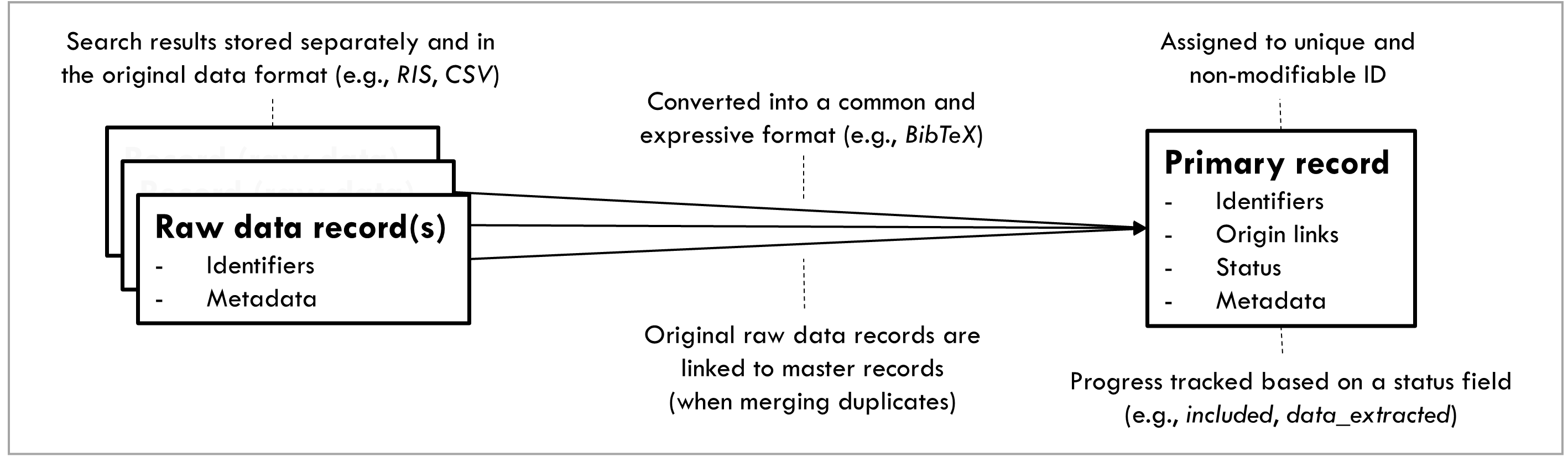
Resources