Notes: Session 9: Big data 2
2026-05-04: 80 min
| Time (min) | Duration | Topic | Additional materials |
|---|---|---|---|
| 0–90 | 90 | TODO |
TODO
- Clarify explanations of RNN and transformers
- Extend: example of backpropagation (in class - Note: when using the http://hmkcode.github.io/ai/backpropagation-step-by-step example - fix typos!)
- Fix inconsistent notation (learning rate: a and )
- Glossary (inductive bias, …)
- The inductive bias of a neural network is the set of assumptions built into the model that shape what kinds of patterns it is likely to learn from data.
- The “simple calculation example” in the ABD slides (PR) is useful to show the actual math. The neural networks videos (https://www.youtube.com/watch?v=aircAruvnKk) explain the effect more clearly (of gradient vector and “cost nudges”). Ideally, students should have a solid intuition, seen the math, and know when (not) to use neural networks.
- Comprehensive resource (formal specification and implementation): https://d2l.ai/index.html
- Maybe start with something like: https://web.stanford.edu/~jurafsky/slp3/slides/nn25aug.pdf
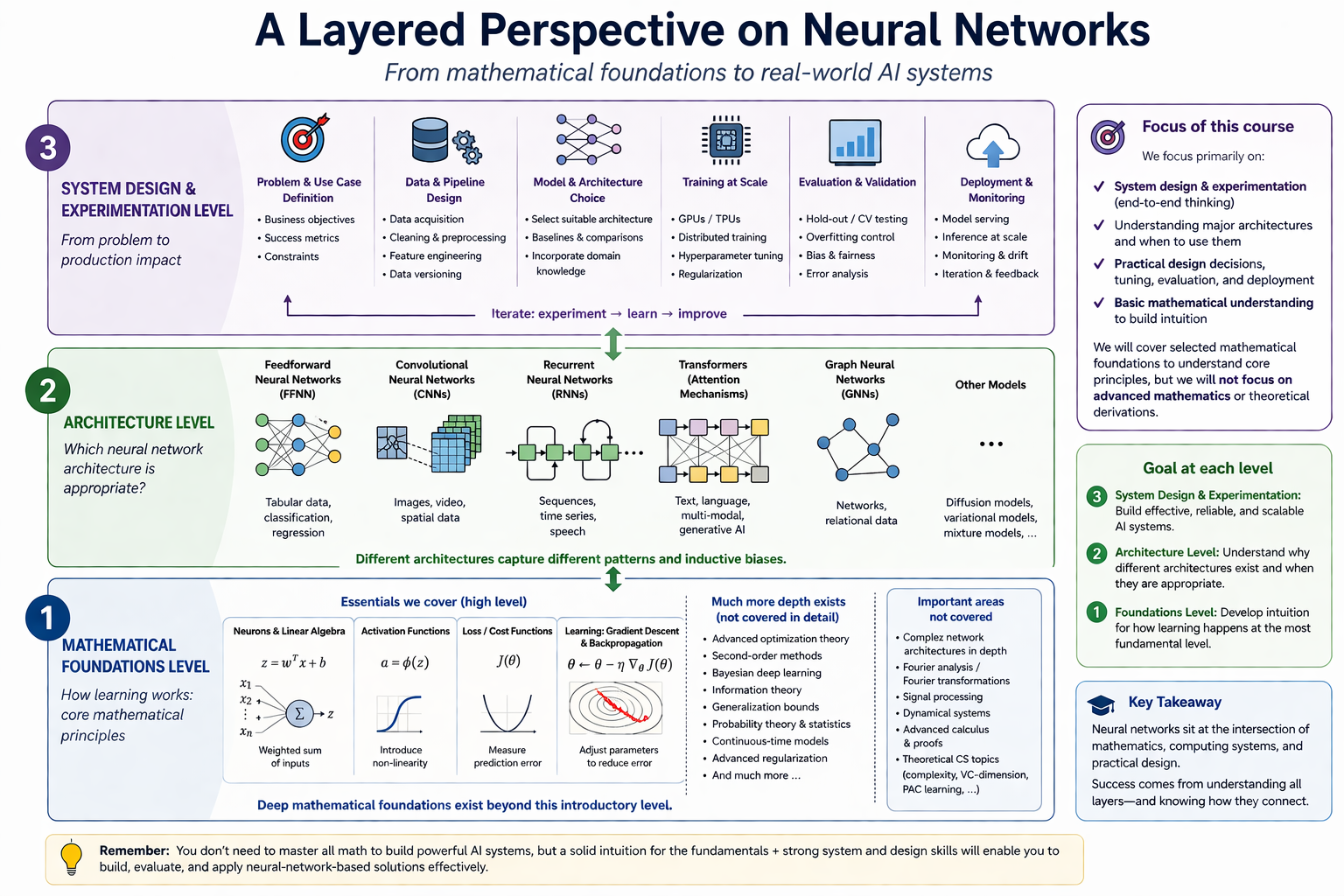
Introductory comments
NN : very inspiring class of models and algorithms, which model how nature solves particular problems. NN: brain, but also: genetic algorithms, or ant algorithms for search problems.
Exercise
2026-05-04: 80 min
Explanation: https://www.youtube.com/watch?v=ru9dXF04iSE&t=10s - but: tasks/learnings are not clearly evident/articulated
Part 4: Optional Reflection Questions
- Which of the use cases involve supervised learning?
- Which use cases involve sequential or temporal data?
- Which use cases are especially suitable for deep learning approaches?
- In which cases might feature engineering still be beneficial?
- Which use cases could raise ethical, legal, or privacy concerns?
- Which tasks require labeled training data and which do not?
- Which challenge tasks are not purely prediction problems?
- Where might optimization or decision models be more suitable than predictive models?
Materials
Neural Networks:
https://www.youtube.com/watch?v=aircAruvnKk
https://www.youtube.com/watch?v=IHZwWFHWa-w
https://www.youtube.com/watch?v=Ilg3gGewQ5U
Good MIT intro https://introtodeeplearning.com/slides/6S191_MIT_DeepLearning_L1.pdf
https://aaubs.github.io/ds23/en/m3/01_intro-to-traditional-dl/
https://github.com/microsoft/ai-for-beginners
TODO: p. 29: binary logistic regression as a 1-layer network: https://web.stanford.edu/~jurafsky/slp3/slides/nn25aug.pdf
Calculate backpropagation:
- Berkeley https://inst.eecs.berkeley.edu/~cs188/archive/fa24/assets/discussions/disc11-examprep-sols.pdf
- Stanford https://cs230.stanford.edu/winter2020/section3_exercises.pdf
- https://mattmazur.com/2015/03/17/a-step-by-step-backpropagation-example/
https://www.ismll.uni-hildesheim.de/lehre/ml-19w/exercises/tutorial07.pdf
Interactive js visualization of NNs: https://github.com/hmkcode/netflow.js
Insight from https://developers.google.com/machine-learning/crash-course/neural-networks/interactive-exercises -> even if all inputs are 0, the output can be non-zero. (due to biases)